
Same Sea, Different Story
How Norway built wealth and Britain spent it

The Same Geology and its Fifty Year Returns
In the late 1960s, two nations discovered they were sitting on one of the most significant hydrocarbon deposits on the planet. The North Sea basin did not discriminate. Norwegian waters and British waters shared the same ancient geology, the same cold grey depths, the same transformative economic potential. Half a century later, one of those nations has a sovereign wealth fund worth over $1.5 trillion — the largest in the world — and now exports gas to the other. That nation imports the gas, cannot fund the maintenance of its own infrastructure, and spent the last decade arguing about whether to issue new licences while its production base quietly collapsed.
Any discussion about energy, or about geology, or even about the rights and wrongs of privatisation is not the goal here. The bone of contention is system design: about who owns what, who can see what, and how consequences of decisions made in the short term are ultimately borne. Get those design variables right and a finite resource becomes a permanent endowment. Get them wrong and the same resource dissolves into the recurrent costs of a state that never stops growing, leaving the next generation to pay for what the last one consumed.
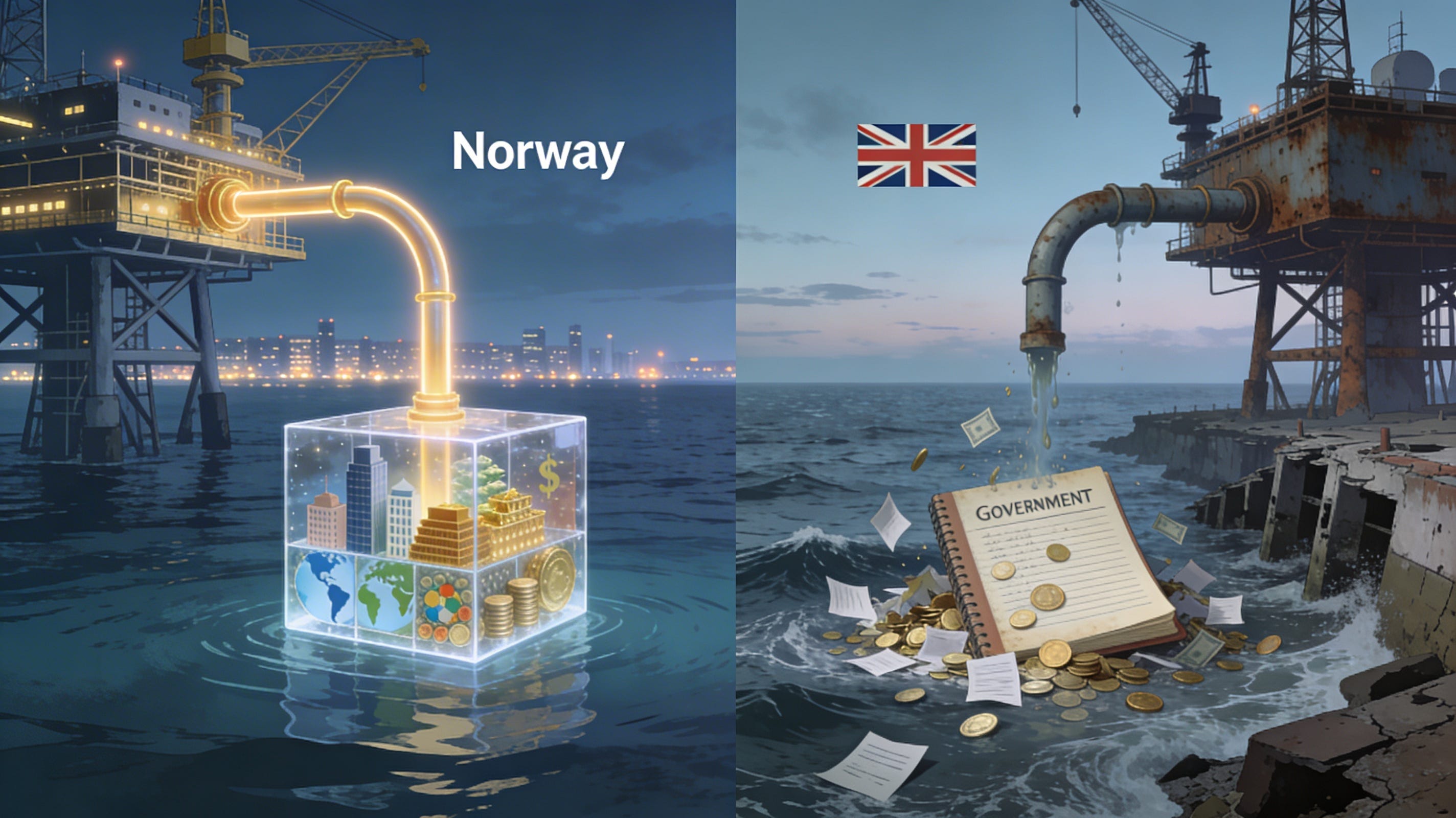
A Parable of Divergence
Norway’s approach was deliberately long-term from the outset. When Statoil was established in 1972, the state took direct equity participation in the resource — not merely a tax take from private operators, but an ownership stake whose returns flowed into public hands. The State’s Direct Financial Interest, managed by Petoro, gave Norway a seat at the table in every significant licence. This was not ideological statism; it was a conscious design choice to ensure that the public, as the sovereign owner of the seabed, would participate in the resource’s upside as an equity holder, not merely as the tax authority standing at the back of the queue.
The consequences for transparency were structural, not incidental. When the Norwegian state owns roughly 67% of Equinor, its stewardship of that stake is publicly mandated, publicly scrutinised, and impossible to obscure. The mandate of the Government Pension Fund Global — save the revenues, invest abroad, spend only the real returns — is written into law and reported with a granularity that makes it one of the most transparent large pools of capital in the world. Every citizen can see what the fund holds, what it earned, and what proportion of national income it represents. Transparency here is not a feature bolted on for optics; it is an intrinsic property of the ownership structure. You cannot be a custodian of public equity and keep the accounts opaque.
Britain’s model was built on a different premise. Privatisation, accelerated under Thatcher in the 1980s, transferred operational control to private operators. State entities like BNOC and Britoil were sold. BP was floated. And this is where a subtlety worth dwelling on enters the picture: privatisation did create transparency of a kind. BP is a publicly listed company with heavily scrutinised accounts, analyst coverage, and disclosure obligations that most state enterprises cannot match. In that narrow sense, the market sees BP clearly.
But what the market sees clearly is BP’s interests, not Britain’s. A listed company’s management is accountable to its shareholders, not to its country of origin. When the economics of the North Sea deteriorated — when mature fields became expensive, when the regulatory environment turned hostile, when better returns beckoned elsewhere in the world — BP and Shell did exactly what their fiduciary obligations required. They redirected capital. They divested. They followed the risk-adjusted return, as any rational operator must. The transparency that attaches to a listed company is the transparency of its own financial performance; it says nothing about whether a national resource is being stewarded in the interests of the nation that owns the seabed.
And beyond the question of corporate mobility, there is the question of who benefits. The proceeds of privatisation and the returns from North Sea operations accrued to those who (a) subscribed to the IPOs, (b) held the stock through the lean years, and (c) had the financial sophistication to participate in that market at all. Not the British state, except via taxation and the IPO proceeds themselves — which, in the absence of any ring-fence or generational mandate, were absorbed into the general churn of government coffers and left no lasting trace. Not the British public, except via whatever tax revenues the Treasury chose to spend, on whatever the political moment demanded. The citizen at the end of this chain is a passive recipient of whatever the system passes down — not an owner, not a stakeholder, not a participant.
Show Me the Incentives
Charlie Munger’s dictum — show me the incentives and I’ll show you the outcome — maps onto this divergence with uncomfortable precision. The incentive facing British policymakers in the 1980s was to maximise near-term fiscal relief. North Sea revenues arrived at a moment of acute economic strain: industrial decline, high unemployment, the costs of restructuring a post-war economy. There was no institutional architecture that required those revenues to be saved, no ring-fenced mandate, no generational obligation written into law. In the absence of such constraints, the system did what systems without constraints always do: it optimised for the short term.
Westminster was optimising for the news cycle, the polling cycle, the electoral cycle. The revenues were spent on tax cuts and current expenditure rather than invested in a compounding fund. Studies suggest Britain received roughly $11 per barrel in government take against Norway’s $30 — a gap partly explained by lower direct ownership and partly by the incentive to keep operators happy in a system where the state had no equity stake of its own to protect.
Norway’s incentive structure was different — and to be fair, its architects showed a political courage that British policymakers conspicuously did not. But courage alone doesn’t compound over fifty years. What sustained the outcome was design: rules that subsequent politicians of more ordinary disposition could not easily override. The rule that oil revenues must not be spent domestically imposed a constraint that forced long-termism regardless of who was in office. The fund’s mandate — invest abroad, spend only real returns — is a self-imposed discipline whose logic is simple: if you cannot spend the principal, you are forced to treat it as capital rather than income. That reframing changes everything. Capital is invested. Income is consumed. Norway chose capital. Britain chose income. The compounding difference between those two choices, across fifty years, is the $1.5 trillion gap that now separates them.
The Geology of Decline Is Real. The Policy of Decline Was a Choice.
It would be convenient to blame geology alone. The UK Continental Shelf is a mature basin; over 90% of its recoverable reserves have already been extracted. Output was always going to fall. But the rate and shape of that decline was not inevitable — it was accelerated by a succession of policy decisions that made the UK an increasingly hostile environment for long-term capital commitment.
Windfall taxes imposed at short notice, regulatory uncertainty, licensing moratoriums signalled with maximalist net-zero rhetoric — each individual decision was defensible in isolation; together they compounded into an unmistakeable message to operators: Britain is not a reliable partner for capital with a twenty-year horizon. BP and Shell, once deeply embedded in the North Sea, steadily divested — not because they are villains, but because they are rational. Exploration wells dropped toward zero in some recent periods. The exploration industry that once trained engineers, funded supply chains, and anchored whole regional economies in Aberdeen and the Humber contracted. Once among the world’s most productive basins, the North Sea now meets only a fraction of Britain’s gas demand — with up to half of national supply arriving through pipelines from Norway.
The Cantillon Effect in Natural Resources
There is a Cantillon dimension to this story that rarely surfaces in the policy debate. The Cantillon Effect describes how newly monetised assets benefit those closest to the source before their value dilutes outward. In natural resource extraction, the mechanism is direct: when a nationally owned resource is monetised via taxation of private operators, the primary beneficiaries are those operators and their shareholders. The public receives whatever the state decides to spend — filtered through all the political distortions that define democratic spending decisions. Last in the queue, as always.
Norway’s model interrupts this chain at the source. By taking direct equity stakes and sequestering the returns in a fund explicitly designed to resist political discretion, Norway created a structure in which the citizen is not the last recipient of diluted value — they are the owner. Every Norwegian citizen theoretically has a proportionate claim on $1.5 trillion of globally diversified assets accumulated from their national resource. Every British citizen has a proportionate claim on a national debt that has now passed 95% of GDP, accumulated in part from the proceeds of spending a comparable resource on the running costs of a state that never saved.
The Cruel Irony of Divergence
Here the story takes a turn that borders on the tragicomic. The Government Pension Fund Global does not sit in a Norwegian vault. It is invested globally — in equities, bonds, and real estate across 70-odd countries. A significant share of those assets are priced in currencies that Western governments, including Britain’s, have spent the last two decades steadily debasing. Every round of quantitative easing, every expansion of the money supply, every inflation surprise that erodes the real purchasing power of sterling and dollars and euros — reprices the fund’s hard assets nominally higher.
Put plainly: when the Bank of England prints money, asset prices rise. The Norwegian fund, which owns those assets, gets richer in nominal terms. The British saver gets poorer in real terms. Britain is transferring wealth to Norway through its own monetary policy — the more aggressively it debases, the more Norway’s stewardship is vindicated.
This is not hyperbole. Norway’s fund buys British gilts, British equities, British real estate. It is one of the largest single investors in the London Stock Exchange. When British monetary policy inflates asset prices, Norwegians benefit. When British fiscal policy requires ever-larger bond issuance, Norway buys those bonds and clips the coupon. The irony is as stark as the divergence in outcomes is tragic: Britain is now, in measurable financial terms, making Norway wealthier through the very policy choices that make its own citizens poorer. It is a deftly malign transfer, executed through entirely legal and unremarkable market mechanisms, that no headline adequately captures. A car crash in slow motion, playing out across decades, visible to anyone who looks but beneath the threshold of political expediency.
Sustainable Architecture of Systems
Norway’s deeper lesson is about institutional architecture: what it takes to make good long-term decisions structurally easier to sustain than bad short-term ones. Norway replicated the discipline of hard money by design: rules that forbade spending the principal, transparency obligations that made deviation politically costly, a mandate embedded across governments of different persuasions. Courage to establish. Vigilance to maintain.
Britain’s monetary framework — with its elastic borrowing capacity and its ability to quietly monetise obligations across time — widened the design space for short-termism by removing automatic consequences. But it did not mandate the outcome. Norway runs a fiat currency too. The kroner is no harder than sterling. What Norway chose, and Britain did not, was to impose on itself the institutional discipline that a harder monetary system would have enforced automatically. It is not that British politicians were simply short-sighted as individuals. It is that the system they designed, or conspicuously failed to design, made short-termism the default — and no one built the override.
Sell the family silver, the future generations can get back to the mines. Or call centres. But most likely, UBI.
The relevant question is not whether Britain could have been Norway. It is whether, the next time a finite national resource presents itself, the institutional architecture will be in place to capture and steward that value for the public that owns it. The signs are not encouraging. Britain currently pays its offshore wind operators curtailment subsidies — money transferred directly from bill-payers to generators to switch their turbines off — because the grid cannot absorb the power they produce. Stranded energy, in a country that imports nearly half its gas from Norway. The resource exists. The means to capture it exist. The political nous to deploy them does not. This is the North Sea story repeating itself in a different register.
The pattern extends far beyond the North Sea. What makes Britain’s position particularly pointed is that some of the world’s least developed economies are solving the very capture problem Britain cannot. Ethiopia generates 98% of its electricity from hydropower — much of it stranded, surplus to domestic grid capacity, supposedly unmonetisable — if you are British. Rather than paying for any excess to be discharged into the ground (yes, really, this is the UK), Ethiopia has partnered with Bitcoin mining operations that consume any excess energy directly, converting a wasted resource into a globally tradeable asset. In 2024, those partnerships generated revenues reported at well over $200 million — from power that would otherwise have been curtailed. El Salvador, with a GDP smaller than Hampshire, has made Bitcoin legal tender and begun accumulating it as a sovereign reserve asset. A country of six million people doing, in digital form, roughly what Norway did in physical form: treating a resource as capital rather than income, building a claim on future value rather than spending today’s. One does not need to share all of El Salvador’s premises to observe that the instinct — capture the asset, hold the asset, let it compound — is precisely the instinct Britain never applied to the North Sea. When developing nations are reading the incentives more clearly than the country that once built the global financial system, something structural has gone wrong.
The Same Sea. Different Stories.
The North Sea did not choose its custodians. The geology, for the sake of argument, was identical on both sides of the median line. What differed was the system: who owned the asset, who could see the accounts, who bore the consequences, and whose incentives were aligned with the long term.
Britain is now a net energy importer, sending money across the North Sea for gas extracted from fields in the same basin where British-licenced fields once thrived. Norway’s fund holds British assets — gilts, equities, property — accumulated from the returns of fifty years of disciplined stewardship of a resource they treated as capital. Britain treated the same resource as income, spent it, borrowed against the future it promised, and is now watching that future arrive.
This is a worldwide pattern, not a British peculiarity. The mechanism — monetise the present, defer the cost, inflate away the evidence — is the operating logic of most modern states. Norway is the exception that illuminates the rule because of the North Sea comparison. Its fund does not just represent Norwegian prudence. It represents the accumulated cost of every country that chose differently: the roads not built, the savings not made, the wealth transferred quietly through inflation to those who held the assets while everyone else held the currency.
Show me the incentives. Norway showed us an incredible outcome. Britain has shown us incredible decline. The tragedy is that both outcomes were entirely predictable from their initial design.
Post Script
The themes of system design, incentive alignment, and the institutional architecture required to sustain long-term stewardship of public wealth are explored at length in aBundance: The Wealth of Networks.